


HP Tuners AI Tuning Assistant: Beyond the Chatbot
HP Tuners AI Tuning Assistant: Beyond the Chatbot
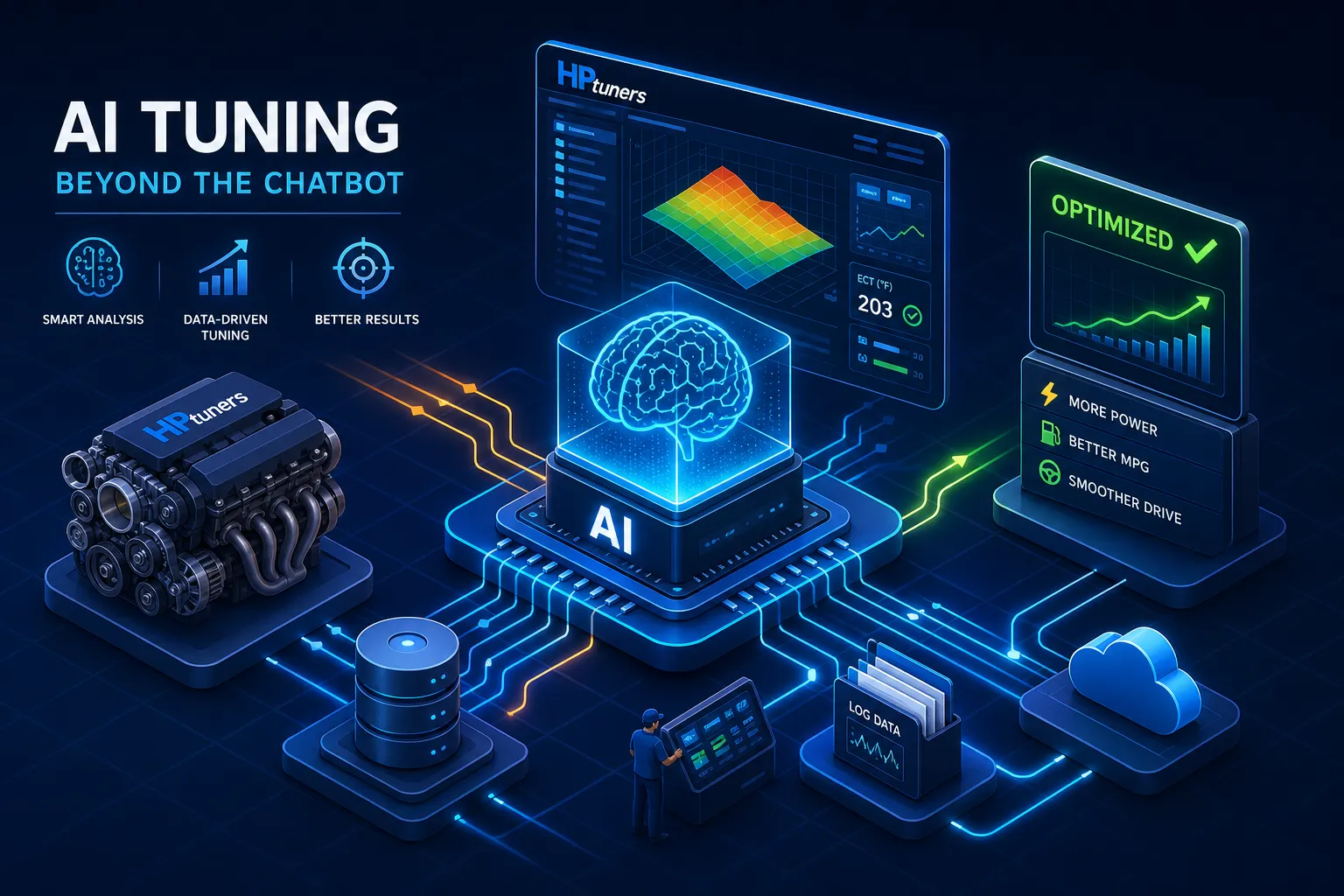
Most tuners searching for an HP Tuners AI tuning assistant end up doing the same thing: pasting their log file into a general chatbot and getting answers that sound authoritative but don't match the actual calibration structure. The advice is confident, the terminology is correct, and the recommendations are wrong in ways that matter. That gap exists because general AI was never built for this job. This article explains what a purpose-built HP Tuners AI tuning assistant actually does, how HP Tuners' native AI features fit into the workflow, and why tools like StreetTunedAI exist to do what a chatbot can't.
Whether you're tuning a cammed LS, a boosted LT, or a Coyote swap, understanding how AI assistance actually works in this context changes how you use it. The distinction between a language model and a structured analysis engine isn't academic. It determines whether you get a calibration direction you can act on or a plausible-sounding guess dressed up in tuning vocabulary.
HP Tuners AI Tuning Assistant vs. General Chatbots
A general-purpose chatbot processes language, not calibration logic. When you upload a CSV from VCM Scanner and ask what's wrong, it pattern-matches against text in its training data. It has no defined rules for what a knock count event means at a given RPM, no concept of evidence requirements for wide-open-throttle fueling conclusions, and no understanding of the difference between a Gen III and Gen IV LS airflow model. The answers can sound right and still be wrong in ways that damage hardware.
A purpose-built HP Tuners AI tuning assistant doesn't start with language generation. It starts with a structured analysis engine that evaluates logged data against defined tuning rules, calculates what the data supports, and identifies where evidence is missing. The AI layer then explains those structured findings in clear tuning language. The analysis drives the output, not the other way around. When required data is absent, a well-built system limits its conclusions rather than filling the gap with a plausible-sounding guess. That discipline is the difference between a useful tool and a liability.
HP Tuners' Native AI Features: What They Do and How They Fit In
The HP Tuners Neural Network Trainer is a cloud-based tool designed for late-model GM and Stellantis vehicles that use neural network airflow models in the factory ECU. The workflow runs through VCM Editor: read the tune, generate VE tables from the current neural network state, edit those tables in the familiar table format, export them for training, upload to HP Tuners' Tuner Tools, download the trained file, and flash it back. One 25-token license covers 30 days of unlimited training passes for a single vehicle. It's an iterative process built around the same table-editing workflow experienced tuners already know, with a cloud training step added between edits and the flash.
AI Fueling is part of the CORE ECU ecosystem and runs through VCM Live. It uses logged TPS, MAF, MAP, and RPM data, plus at least one working lambda sensor, to learn fueling behavior across the engine's operating range. From there, tuners can generate updated VE and MAF tables or run a full neural network training pass that automatically applies the result to the tune file. MAF is optional but improves accuracy. The documented workflow is straightforward: connect CORE in VCM Live and record a driving log that covers the target RPM and load range. Save the log, then generate or train and apply. This is purpose-built for the CORE ECU platform, not a bolt-on feature for legacy tunes running on factory controllers.
What Your Datalogs Are Actually Telling the AI
Not every logged channel carries the same diagnostic weight. For fuel system analysis, short-term and long-term fuel trims on both banks, wideband lambda, commanded versus actual AFR, and injector pulse width are the signals that matter most. Knock retard and knock count tell a different story depending on where in the RPM range they appear and what the load axis shows at the same moment. MAF voltage versus calculated airmass reveals scaling errors. A purpose-built HP Tuners AI tuning assistant knows which channels are load-bearing for which conclusions, and it evaluates them together rather than in isolation.
Required Log Channels for LS/LT Fuel Trim and VE Work
The minimum log set for LS and LT fuel trim and VE work includes RPM, MAP or load axis, STFT and LTFT on both banks, commanded lambda, wideband lambda, knock retard, spark advance, IAT, and ECT. That combination gives you trim behavior for VE and MAF correction, combustion safety data for knock analysis, and enough context to identify where in the table the issue is occurring. If fuel pressure is available, log it. Fuel delivery problems mask fueling table errors and are easy to miss without the data.
Evidence Gating Rules
Evidence requirements matter more than most tuners realize. If the wideband data in a log is unreliable, a well-built analyzer should not generate WOT fueling conclusions, because the evidence doesn't support them. If an LS datalog is missing knock retard data, the system should flag the gap rather than assume timing is clean. This evidence-gating approach prevents the system from producing actionable-sounding recommendations that aren't grounded in what the log actually contains. General AI doesn't apply this discipline. Neither do HP Tuners' native tools across the full tuning workflow, and that's the gap a platform like StreetTunedAI is built to close.
StreetTunedAI: Persistent Context Across Every Session
StreetTunedAI was built around a problem that every tuner working through multiple revisions eventually runs into: by the third or fourth log review on the same vehicle, you're rebuilding context from scratch every time. The LS/LT portal stores vehicle build information, modifications, previous analyses, calibration changes, and follow-up log results so the workflow continues where it left off. When a new log comes in after a VE table revision, the system already knows what changed and what the last session flagged as needing attention. That persistent memory is the operational difference between a one-time analysis and a tuning workflow.
StreetTunedAI doesn't flash the PCM or push calibration changes directly. It analyzes the log using a deterministic engine built on defined LS/LT tuning rules, then communicates what the data supports and what the tuner should address next in VCM Editor or EFI Live. That separation is intentional. The platform provides another set of eyes and a reliable memory across large datalogs and multiple revision cycles. The tuner reads the findings, makes the call, and applies the change. It works the same way for a DIY enthusiast learning their first cammed LS tune as it does for a shop managing a full tuning calendar with multiple vehicles at different stages.
HP Tuners AI Tuning Assistant: A Practical Workflow from First Log to Validated Revision
Start with a log that covers the operating conditions you're trying to evaluate. For fuel trim work, that means idle, cruise, and part throttle with stable coolant temperature. For VE accuracy, you need clean, steady-state pulls across the RPM range with consistent operating conditions. Upload the log to your analysis tool, review the structured findings, and pay attention to what the system flags as missing or inconclusive. That second output, what to log next, is often more useful than the initial findings, because it shapes the next data collection run with intention rather than guesswork.
After a VE table edit or PE table change, the follow-up log is where the work gets confirmed or corrected. A well-built HP Tuners AI tuning assistant compares the new log against the previous session's findings and identifies what improved, what stayed the same, and what needs another pass. This iterative structure, log, analyze, revise, validate, repeat, is what separates a disciplined tuning workflow from a single-session attempt. It's also where persistent vehicle context pays off: the system already knows where the last revision left the tune, what the trims looked like before, and what the original flags were.
Where AI Assistance Ends and Tuner Judgment Begins
Across HP Tuners forums and tuning communities, the pattern is consistent. AI is useful for explaining concepts, identifying obvious problems, and speeding up repetitive setup work. It's least reliable when the task requires ECU-specific calibration structure knowledge, exact safety margins, or nuanced judgment about how an engine is behaving under conditions the log doesn't fully capture. Fuel trims can mask underlying problems. A tune that runs clean in closed loop may not be safe when those corrections are removed or conditions change. That's a judgment call that still belongs to the tuner.
The most common failure mode the community reports isn't a bad recommendation from the AI. It's skipping validation. No proper datalogging after a change, no confirmation of battery and ground health before a flash, no verification that sensor inputs are reliable before trusting the analysis. Every AI-generated calibration direction should be reviewed against what you know about the engine combination before it goes into the ECU. Log validation after each change is non-negotiable, regardless of how confident the analysis looks. The tools covered in this article, the HP Tuners Neural Network Trainer, AI Fueling, and StreetTunedAI, are all designed with that principle in mind. They inform the tuner. The tuner owns the result.
Pulling It Together
An HP Tuners AI tuning assistant is only as useful as the logic it runs on. HP Tuners' native AI features handle specific tasks well, particularly VE table refinement on neural-network ECUs and fueling learning on CORE hardware. For tuners who need structured datalog analysis, evidence-based calibration direction, and persistent vehicle context across an iterative tuning job, a purpose-built platform like StreetTunedAI delivers something different and more complete, and that difference compounds across every revision cycle.
It's not a chatbot. It's not a flash tool. It's a second set of eyes with a reliable memory, and on a complex build with multiple revision cycles, that combination is worth more than any single-session analysis. If you're working through a cammed LS, a boosted LT, or any build where the tuning job spans multiple logs and revisions, start a session with StreetTunedAI to see how the platform fits your workflow.