

7 HP Tuners Tables to Adjust After an LS Cam Swap
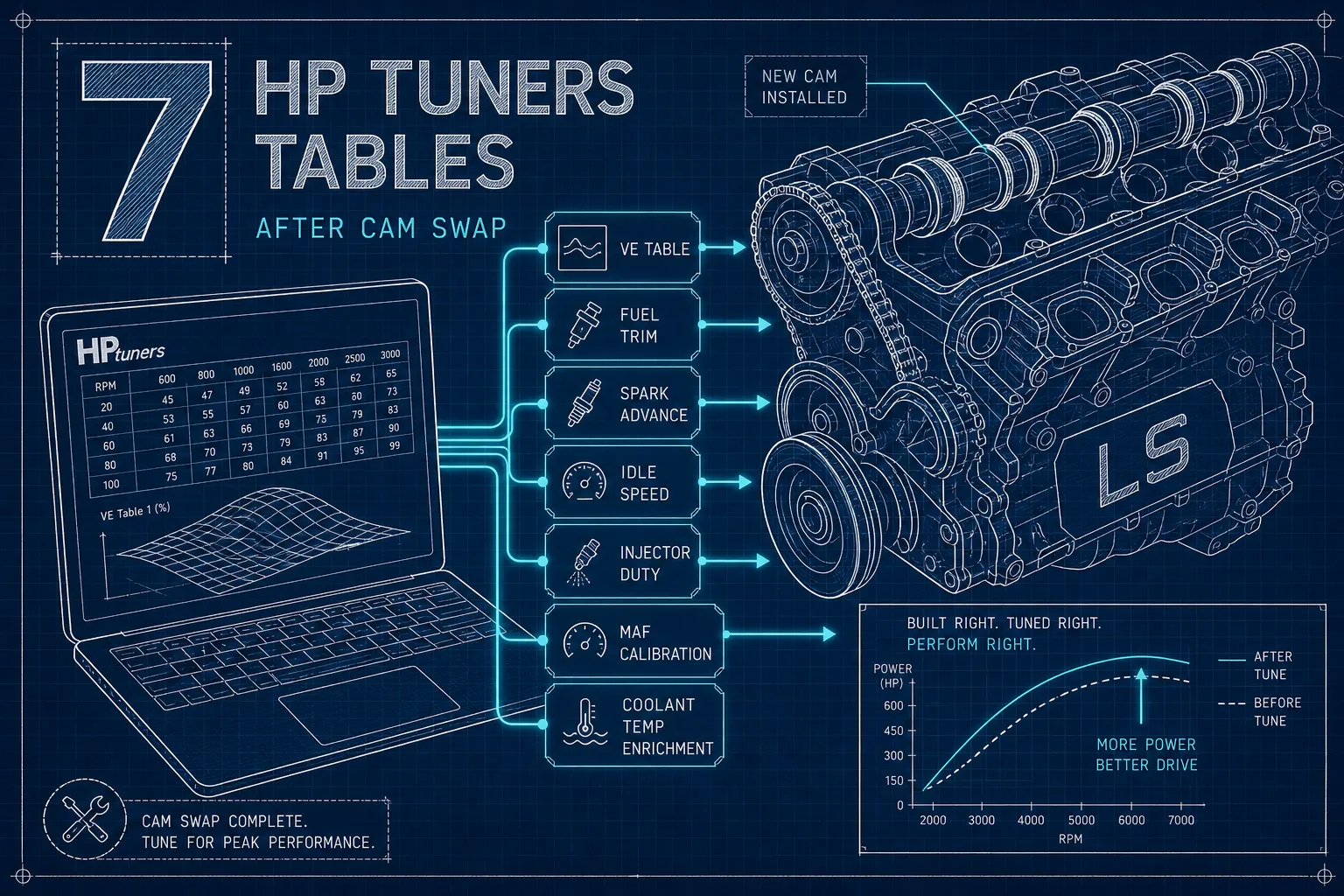
If you're wondering what HP Tuners tables need adjustment for a cammed LS, start with idle and work outward from there. The cam swap is done, the engine is running, and the factory tune is now wrong in multiple places, the idle speed tables, base running airflow, idle spark, VE table, MAF calibration, power enrichment, and misfire thresholds. That is not a guess. The PCM was calibrated around a stock cam profile, and every aggressive cam you bolt in changes the airflow model, the vacuum signal, the idle authority, and the combustion event timing. All of those assumptions baked into the stock calibration are now off.
This guide covers which tables to touch, in what order, and why each one matters. You will also get safe baseline adjustments to get the car driveable before fine-tuning begins. At the end, we will cover how a datalog-driven tool can flag exactly which of these tables still need attention based on real evidence from your specific build after the first drive, not based on guesswork.
Why an aggressive cam breaks the factory tune
The factory ECM calibration assumes a specific airflow curve, a predictable vacuum signal at idle, and a stable combustion environment across the RPM band. An aggressive cam with significant overlap blows all three of those assumptions out. Increased overlap reduces intake vacuum at idle, confuses the MAF's airflow model, and shifts the engine's efficiency curve up in the RPM band where the cam actually breathes.
The symptoms you see after a cam swap are not random. Rough idle, hunting, stalling, lean spikes, and poor part-throttle response each map directly to a specific table that is still calibrated for a stock cam. Understanding that connection is what separates a tuner who knows what they are correcting from someone who is just turning knobs and hoping something improves.
How overlap changes airflow and vacuum
High overlap means both the intake and exhaust valves are open simultaneously for a longer portion of the cycle. At idle and low RPM, this causes reversion, exhaust gases pushing back through the intake side. The result is lower and less stable manifold vacuum, and the MAF sees a distorted airflow signal that no longer reflects what is actually happening inside the cylinder. The PCM has no idea this changed, so it keeps making fuel and spark decisions based on an airflow model that is now measuring something different from what the cam is actually doing.
Why the PCM's fuel and spark models are working off bad assumptions
The VE table, the MAF calibration, and the spark tables were all built around a specific volumetric efficiency curve. A big cam moves that curve. Low-RPM cylinder filling drops, mid-to-high RPM filling improves, and the PCM is stuck using the old numbers.
Until you correct those tables, the engine is running on bad math. The VE table in particular becomes the most direct mismatch, the PCM is predicting cylinder filling that no longer matches what the cam's overlap profile actually delivers at low and midrange RPM. No amount of hoping will fix it.
What HP Tuners tables need adjustment for a cammed LS, idle tables first
Most cam tune guides start here, and for good reason. If idle is not stable, none of your datalog passes for VE or MAF scaling will be clean enough to trust. Dirty idle data produces bad corrections, and bad corrections create a longer, more frustrating process. Get the idle stable first, then build on it.
Target idle speed: how much to raise it and why
Raise the target idle RPM in the ECT-based idle speed tables to match what the cam actually needs. For mild overlap cams, 850 to 900 RPM is a reasonable starting point. For larger overlap profiles, 950 to 1,100 RPM is where most builds end up. These ranges reflect common starting points documented across HP Tuners-based LS tuning workflows, your final target will depend on the specific cam and engine combination. Raising the target without also adjusting airflow leaves the IAC fighting to compensate, which causes hunting. You have to raise both together.
Base running airflow and IAC authority after a cam swap
Increase base running airflow so the engine is not relying on the IAC with the blade too close to closed. A common starting move is plus 1 to 4 g/s across the table, or roughly 15% above stock as an initial pass. When the airflow table is set correctly, you should see IAC counts around 30 to 50 in park or neutral and up to around 120 in gear under load, these are widely referenced baseline targets for cammed LS builds and should be confirmed against your specific logged data. If IAC counts are pegged near zero or maxed out, the airflow table is the problem.
Idle spark advance: getting combustion stable before tuning fuel
A cammed LS typically needs more idle spark advance than a stock engine. A safe starting point is 15 to 18 degrees, with many builds landing between 18 and 24 degrees once dialed in, values consistent with established LS idle tuning guidance, though compression ratio and fuel quality will shift your specific target. The key is to keep the idle region of the main spark table smooth, with no more than 1 to 2 degree steps near the target idle RPM.
What HP Tuners tables need adjustment for a cammed LS, VE table and MAF scaling
Once idle is stable, fueling correction is the next layer. Whether you address the VE table or MAF scaling first depends on your setup, but the logic is the same either way: the engine's actual airflow behavior no longer matches what the calibration predicts, and you need to correct that before the data from your logs means anything reliable.
VE table changes by RPM and load region
The low-RPM, low-MAP cells in the VE table need the most attention. That is where cam overlap has the largest effect on cylinder filling efficiency. Midrange VE corrections of 5 to 10% are a common starting point, refined from wideband logs after the car is driveable. High-RPM corrections should only be made where logs show a confirmed AFR error, not as a blanket scaling move. Applying corrections without log evidence in the top of the RPM range is one of the most common ways a cammed LS tune gets messy.
MAF scaling workflow after a cam swap: the step-by-step approach
For MAF-based setups, the workflow is straightforward but requires discipline. Disable closed loop fuel control and dynamic airflow influence so the PCM is not chasing corrections while you log. Run steady-state driving passes to collect MAF frequency data across the operating range, then apply percent-based corrections to the MAF airflow versus frequency table using paste special in HP Tuners. Two to three iterations is typically enough to get the MAF dialed in when the process is clean.
When to use speed density instead of MAF scaling
If the cam has made the MAF airflow model unreliable at idle and low RPM, the cleaner path is to temporarily force speed density mode, calibrate the VE table, and then restore the normal configuration so MAF and speed density can blend together as intended. This is the correct sequence when the MAF's signal is too distorted at low RPM to build an accurate correction from, not a workaround.
Spark timing tables that need adjustment after a cam swap
Spark is where most cam tune problems get hidden. When fueling is off and idle is unstable, some tuners reach for timing as a band-aid, which creates a mess that takes much longer to untangle. Correct the fueling first, then the spark tables become a straightforward exercise.
Main spark table and idle spark regions: where to start
The tables to touch are the main spark table, the idle spark table, and the overspeed and underspeed idle spark correction regions. The idle and base idle spark tables want 18 to 24 degrees as a starting point, with many cammed street setups landing around 20 to 25 degrees depending on compression and fuel quality. Keep the idle region of the main spark table smooth with small, even steps near the target idle RPM. The overspeed and underspeed correction regions should be softened, not tightened, if those corrections are too aggressive, the engine surges. Dial them down and let the airflow table carry more of the idle stability load.
Safe starting timing values for a cammed LS street tune
Spark should fine-tune what airflow established, not compensate for an airflow table that was never adjusted. If idle is still hunting after setting timing in the 18 to 24 degree range, go back and verify the airflow table before touching timing further. The overspeed and underspeed correction tables are a common place where tuners over-tighten the correction response, keep those regions conservative and let RPM stabilize through airflow management first.
Power enrichment, fuel trims, and the tables most tuners skip
After the core fueling and spark work, there are three areas that regularly get overlooked until the car goes back on the road and the problems show up again. These are not optional. They are just the tables that do not announce themselves loudly at first.
Power enrichment table adjustments at WOT
A cam swap often changes what the engine needs at wide-open throttle, especially in the low-to-mid RPM range where the cam's powerband is coming online. The power enrichment table controls WOT fueling targets, and if it is still set for a stock cam, the engine may run leaner than intended in the early part of the pull. Log a WOT pass with a reliable wideband before assuming the PE table is fine.
Reading fuel trims as a map of remaining tuning errors
Long-term fuel trims are the PCM's record of where the calibration is wrong. Negative LTFTs at idle mean the engine is running rich there. Positive LTFTs mean it is lean. When you read LTFTs by operating region across a datalog, you get a clear picture of exactly which cells in your VE or MAF table still need correction. It is how the data tells you where the work is not done yet.
Misfire table desensitization for high-overlap cam profiles
High-overlap cams produce cylinder pressure events that the factory misfire detection algorithm reads as misfires, even when combustion is perfectly healthy. Without adjusting the misfire tables, the PCM may pull timing or set P0300 codes based on false positives. The fix is to raise the misfire count thresholds in the low-RPM and idle regions of the misfire tables under Engine Diagnostics. Many tuners start by increasing low-end values by 20 to 100% as a baseline; for very large cams, some set idle-region cells to the maximum value entirely, though the appropriate range depends on cam size and how well idle airflow and fueling have already been corrected. The critical rule is to fix idle airflow and fueling first, then address misfire desensitization. Raising misfire thresholds on top of a tuning problem masks real issues.
How to find what still needs work after your first drive
Making the initial table adjustments gets the car driveable. Finding out what still needs work requires clean datalog evidence from your actual build running under real conditions. This is where the process either becomes a structured workflow or a guessing game.
Key datalog channels to log after a cam install
Log the following channels across idle, part throttle, cruise, and a wide-open throttle pull:
- Wideband lambda
- Short-term and long-term fuel trims
- IAC counts
- MAP
- MAF in grams per second
- Knock retard counts
- RPM
These channels together give you a complete picture of what the PCM is seeing and where its model still does not match the engine's actual behavior.
How StreetTunedAI flags which tables still need attention
StreetTunedAI processes those datalogs through a deterministic analyzer built specifically for HP Tuners workflows. It evaluates the logged data against defined tuning logic, identifies which tables still have evidence-based errors, and flags exactly what the data supports before making any recommendations. If the required data is not present or reliable, the system will not invent a conclusion. That matters because a wideband that was not logging during a WOT pull should not be used to make WOT fueling calls, and StreetTunedAI's evidence-based safeguards enforce that boundary.
Keeping continuity between revisions instead of re-diagnosing from zero
Because StreetTunedAI maintains vehicle-specific build context and tuning history, it knows what was already adjusted and what the follow-up log revealed. You are not starting from scratch after every calibration revision. The system tracks where the tuning job left off, which means each pass of logs moves the build forward instead of repeating the same diagnostic loop. For anyone managing multiple revisions on a cammed LS, that continuity is not a nice-to-have feature. It is what separates a finished tune from an endless cycle of re-diagnosis.
Get the baseline right, then let the data drive the rest
The sequence matters. Idle tables first. Fueling next. Then spark. Then the tables most tuners skip: power enrichment, fuel trims, and misfire desensitization. That order exists because each layer depends on the one before it being stable enough to produce trustworthy data.
Knowing what HP Tuners tables need adjustment for a cammed LS is only half the answer. The other half is having clean data that confirms whether your changes actually worked. A calibration change without a follow-up datalog is a guess. A follow-up log without the right channels logged is still a guess. Log early, log often, and use the evidence.
If you want a faster path through that evidence, upload your datalogs to StreetTunedAI and let the analyzer tell you exactly where the remaining errors are and what the data supports. The car built the evidence. Use it.