


Is StreetTuned AI Worth It for LS Engine Tuners?
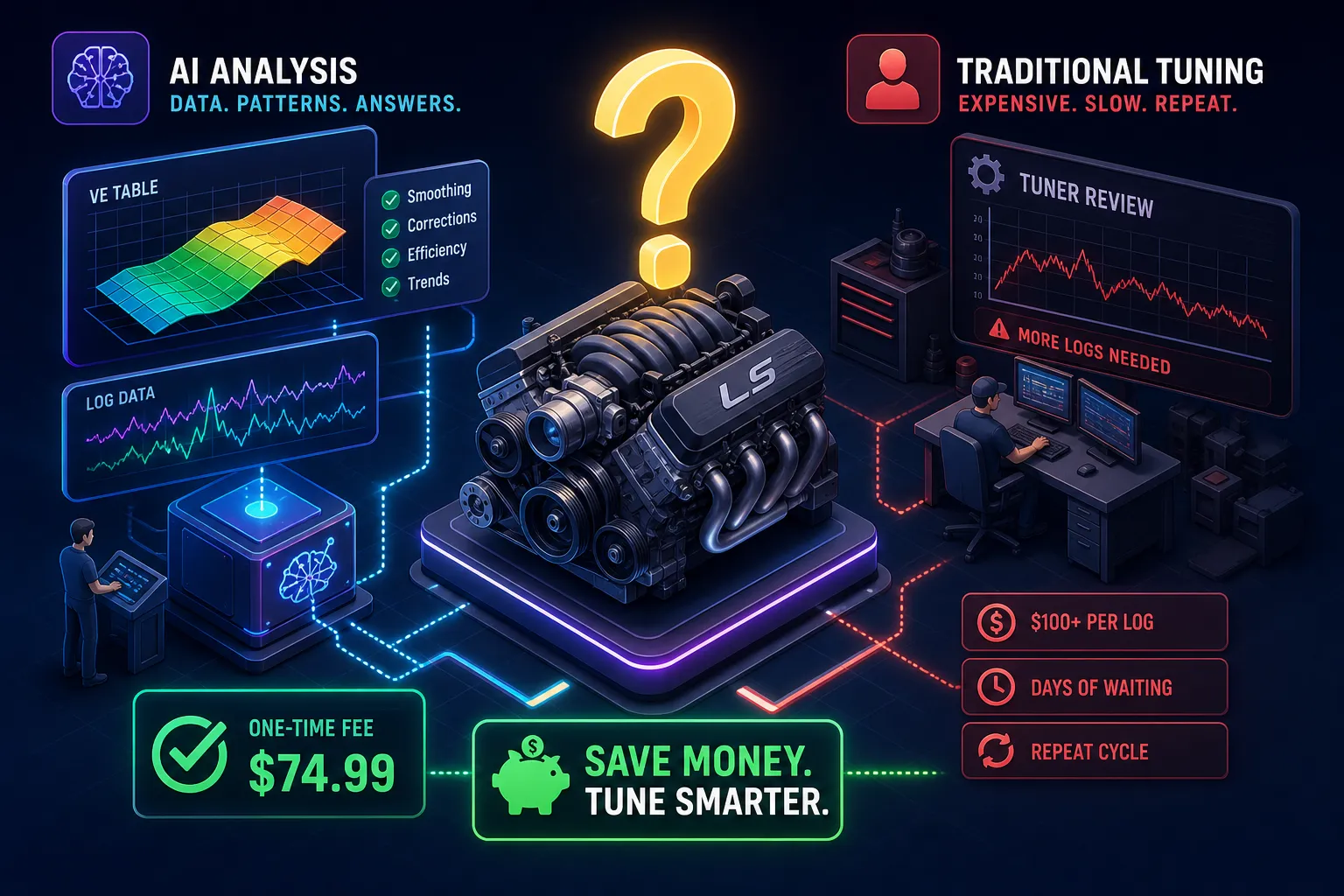
Every time you pull a log on an LS build and need real feedback, you're burning something: time, money, or a favor. Remote tuners charge per session. Forum advice ranges from decent to dangerous. And sitting on a log without acting on it just means leaving performance on the table. If you've been asking whether StreetTuned AI is worth it for LS tuning, this is the straight breakdown you're looking for, what the platform does, how accurate the feedback is on LS-specific parameters, what it actually costs compared to paying a tuner per session, and who it's genuinely built for. No fluff, no sales pitch disguised as a review.
StreetTunedAI is a patent-pending automotive tuning analysis platform built for HP Tuners and EFI Live users. It uses a deterministic analysis system with defined tuning logic, calculations, channel validation, vehicle context and safety rules to evaluate real datalogs before any AI explanation is generated. The AI does not make the tuning decisions, override safety rules or invent unsupported corrections. Its job is to explain the analyzer’s findings in plain language and help the user understand what the data supports, what should not be changed, and what needs to be logged next..
What StreetTunedAI Actually Covers for LS Engines
StreetTunedAI supports LS and LT tuning workflows across multiple GM controller generations, including common Gen III, Gen IV and Gen V combinations. The exact analysis available depends on the vehicle, controller and channels contained in the datalog. The system analyzes the information that is actually available rather than assuming missing data exists.
Depending on the log, StreetTunedAI can analyze airflow, commanded and measured fueling, short- and long-term fuel trims, spark advance, knock retard, injector behavior, MAP and MAF data, idle behavior, throttle behavior and transmission operation where supported. It uses those findings to point the user toward the relevant calibration area and the next data that should be collected.
Correct logging is critical. StreetTunedAI can analyze closed-loop fuel trims, commanded fueling, airflow behavior and other useful data without a wideband. For reliable WOT and high-load fueling analysis, however, measured AFR or lambda from a properly configured wideband is required. If the data needed to support a safe recommendation is missing, StreetTunedAI is designed to identify what needs to be logged next instead of guessing.
Walking Through an Actual LS Log Review Session
The workflow is straightforward. Export your HPL or CSV log from HP Tuners VCM Scanner, then upload it to StreetTunedAI along with your build details: engine variant, camshaft specs, injectors, any forced induction hardware, and your current calibration baseline. This context matters. The platform uses it to calibrate its analysis rather than treating every log like it came off a stock truck. A log from a 5.3 with a stock cam and factory injectors reads differently than one from an LS3 with a 228/236 cam and 60-pound injectors, and the platform accounts for that.
What comes back is specific. A typical review surfaces flagged VE cell deviations, inconsistent spark advance behavior at defined load sites, lean or rich bias in fuel trims broken out by cruise versus load conditions, and whether injector scaling looks aligned with commanded pulse width. The feedback explains the reasoning behind each flag and points directly to which HP Tuners table to touch, not just "your fuel trims are off," but where in the VE table the error is concentrated and how to correct it.
From there, you apply the supported change in your calibration editor, flash the PCM, run the same type of driving session again, and upload the new log. This is the actual rhythm of tuning: log, analyze, change, flash, verify and repeat. StreetTunedAI is built around that process instead of pretending one log can produce a finished tune. The number of revision cycles depends on the vehicle, the condition of the existing calibration, the hardware combination and the quality of the logged data.
Is StreetTuned AI Worth It for LS Tuning? Accuracy on Key Parameters
On VE table and airflow model corrections, the platform performs well in the conditions where fuel-trim-based correction is most reliable: part-throttle cruise, steady-state load, and closed-loop operation with clean data. It interprets airflow model error against expected VE behavior for the hardware you've specified and gives you cell-level guidance on where corrections need to go. For most of the RPM and load range where your engine spends its time driving, this is genuinely useful feedback.
StreetTunedAI identifies knock-retard events, including where they occur by RPM and load, their severity and whether similar events repeat under similar conditions. Repeated KR can justify further investigation or conservative timing changes, but a datalog alone cannot always prove whether an event is true detonation, false knock or another source of noise. The system also does not recommend adding timing simply because knock retard is absent.
The area where human judgment still needs to be in the loop is WOT and boost transitions. Any aggressive spark advance change or fueling correction at wide-open throttle requires wideband confirmation and conservative, incremental testing. StreetTunedAI compresses the analysis time between log pulls, but it doesn't replace the responsibility of validating your changes with real data on the road or the dyno. The platform is upfront about this, which is a point in its favor.
The Honest Cost Math: StreetTuned AI for LS Tuning vs. Paying a Tuner Per Log
Professional remote tuning and individual log-review services can become expensive when several revision cycles are needed. StreetTunedAI uses a different pricing model designed to let users review multiple logs without paying a tuner separately for every individual log. That can make it more practical for a DIY tuner who works through a vehicle one log at a time. Current pricing and access details should be checked directly on the StreetTunedAI product page because those details can change.
That said, there are situations where paying a shop makes more sense. Complex forced-induction builds pushing the limits of safe spark and fuel targets benefit from experienced eyes and live communication. First-time tuners who need live coaching rather than written recommendations will get more out of a real tuner's time. Builds running unsupported standalone ECUs simply aren't in scope for this platform. Know which category you're in before you spend anything.
Who Should Buy StreetTuned AI for LS Tuning, and Who Should Pass
The primary use case is the DIY GM tuner using HP Tuners or EFI Live who wants to understand the vehicle’s datalogs and work through the calibration systematically without paying for every individual review. If you're pulling logs, trying to interpret fuel trims, airflow behavior, knock activity, idle problems or other tuning data, this is the kind of workflow StreetTunedAI was built for. The exact analysis available depends on the vehicle, controller and channels contained in the log.
Independent tuners handling multiple vehicles can also use StreetTunedAI as a second set of eyes on a datalog. Cross-checking a log against StreetTunedAI’s analyzer can help identify patterns, organize findings and point out areas that deserve a closer look before a calibration decision is made. The system is not intended to replace an experienced tuner. It gives the tuner another way to review the evidence and work through the log systematically.
The fit is straightforward: if you're using HP Tuners or EFI Live with a supported vehicle and are willing to work through multiple log-and-revision cycles, StreetTunedAI fits that process well. A properly configured wideband is required for reliable WOT and high-load fueling analysis, while many idle, cruise, fuel-trim, airflow and other diagnostic reviews can still be performed from the available logged data.
The Bottom Line on StreetTuned AI for LS Tuners
StreetTunedAI is worth it for LS tuners already in the HP Tuners ecosystem, running a supported GM PCM, and willing to do the iterative work that good tuning requires. Depending on the access tier you select, the flat fee structure can cover enough log reviews to make a genuine dent in a street build's development cost, without the recurring expense of hiring a remote tuner for every session.
It's not a magic button. It doesn't replace proper logging, a wideband when measured fueling data is required, careful calibration changes or common sense at wide-open throttle. But as a tool for reducing the time spent digging through datalogs and figuring out what matters, StreetTunedAI gives LS and LT tuners a structured way to understand the data, identify supported calibration changes and determine what needs to be logged next. If you have a log sitting idle and you are trying to figure out what the vehicle is actually telling you, that is exactly where StreetTunedAI fits.